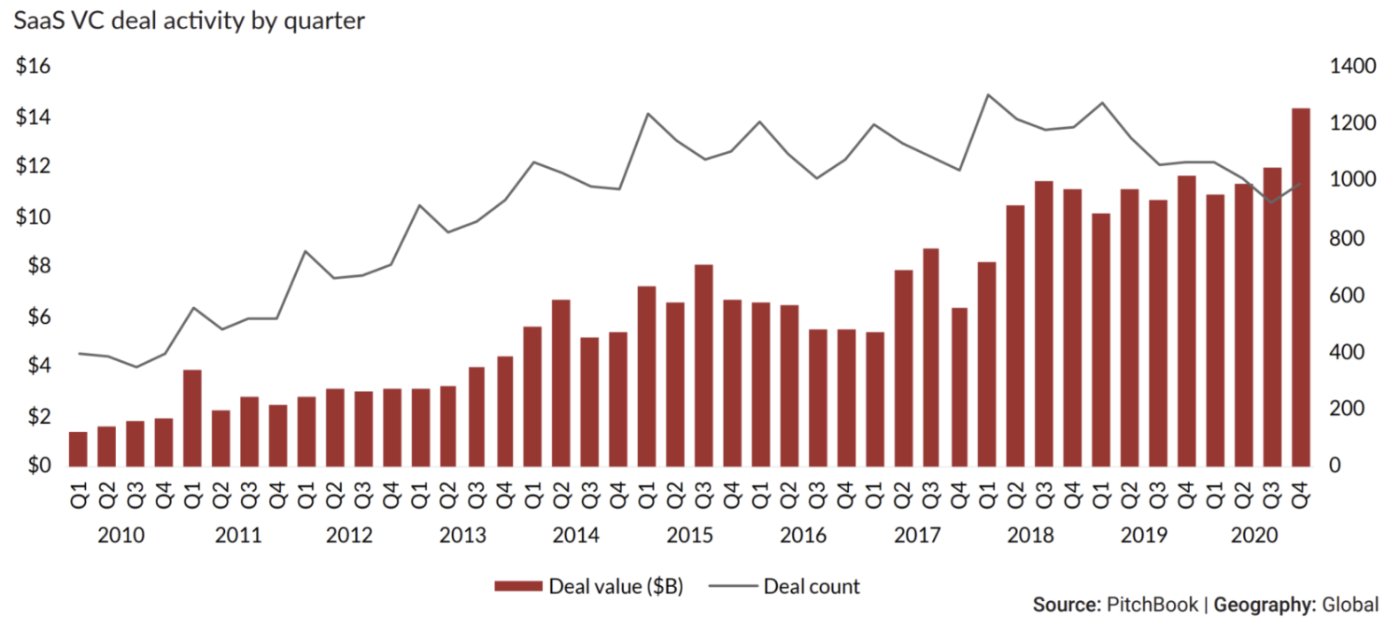
SaaS has been a huge area of investment for VC's over the last decade. Over $48 billion was invested in 2,600+ companies in 2020. There was a huge increase again in 2021, with $94 billion invested in 4,400+ companies.
I believe Venture Capitalists are nearly always using a "penetration pricing" economic model (or variations thereof) when they invest in a vertical market SaaS company (the "VMS Investee").
The VMS Investee usually targets capital constrained customers who are often small or just starting to computerise. They initially offer a combination of most of the following:
- rock bottom pricing (sometimes transaction-based);
- attractive and user-intuitive interfaces;
- remote installation and training; and
- 7-24 on line chat and automated knowledge-based support.
The margin on this low-priced offering is usually extremely negative (-50% EBITA/Net Revs for 3-5 years), but the product is easy to market on-line, and the low cost elicits customer trial. Through rapid iteration (a huge benefit of the SaaS technical deployment model) the VMS Investee reduces customer acquisition costs and infant mortality.
Once the customers' switching costs have ramped up (i.e. their users have become familiar with the product and it has been woven into their daily workflows) and the VMS Investee has a large user base, the Investee exercises its pricing power. Price may be a function of maintaining transaction-based pricing as the customer grows, increasing the basic price as functionality is improved, or bundling other products (e.g. payments, professional services, APIs). Nearly all successful new SaaS businesses have significant logo attrition in each vintage, but this is more than offset by their same client year over year revenue growth as they exercise their pricing power within their more established vintages.
This penetration pricing strategy requires significant expansion capital once attractive customer acquisition costs and switching costs have been proven. It is ideally suited to venture capital. The VCs can invest small dollars early, in essence buying an option. If the option pays off, and the potential lifetime value of the acquired customers proves attractive, the VC can then invest much more capital at low risk to expand the company within the constraints of the addressable market.
Optimistically, 20% of VC backed investees may be successful. The number you usually hear is closer to 10%. Nevertheless, SaaS has attracted a disproportionate amount of VC over the last decade, so I believe the value generated by the successes has more than offset the losses generated by the 80%-90% that don't make the grade.
Clearly the above model is not a "no-brainer". Each low end SaaS start-up is going to require several million dollars to launch and many more million to expand. Most of our business units have less than 50 employees, and the vast majority have less than 100. They are not about to destroy their bonus for multiple years in the 10%-20% hope of launching a successful low end SaaS business in their own vertical.
That's where VMS Ventures comes in: we are targeting exactly this kind of investment and are keen to back internal entrepreneurs and to take the start-up losses off your books for bonus purposes. We encourage our closeted entrepreneurs and ambitious business unit general managers to contact Karl Schabas (karl.schabas@vmsfund.com) if you'd like to discuss launching a low-end VMS SaaS business.